Introduction to Hyperspectral Imaging for Damage Assessment
Many materials and chemicals, such as Methane or Ammonium Nitrate, are invisible to the naked eye and notoriously difficult to detect. Advanced sensor technologies, such as the hyperspectral imaging (HSI) sensors used by Orbital Sidekick’s (OSK’s) Global Hyperspectral Observation Satellite (GHOSt) constellation, excel at chemical fingerprinting and identifying subtle atmospheric and surface anomalies. This post explores the application of HSI to assess the impact of a recent military operation.
Background: The Fordow Fuel Enrichment Plant
OSK analysts employed HSI from the GHOSt constellation to evaluate the effects of "Operation Midnight Hammer," a U.S. military strike on the Fordow Fuel Enrichment Plant in Iran on June 22, 2025. The facility is situated deep underground beneath a mountain range, with minimal above-ground infrastructure. The strike, which involved B-2 Spirit stealth bombers deploying bunker-buster bombs, has led to international debate and speculation regarding the extent of the damage caused to the underground facility.
High-resolution RGB imagery from commercial satellites (e.g., Planet and Maxar) captured before and after the strike provided initial visual evidence. Figure 1 and Figure 2 show high-resolution RGB images of the facility pre- and post-bombing. These images reveal tunnels, roads, and support buildings. The post-strike imagery highlights new surface features.
A closer examination, as depicted in Figure 3, reveals five to six entry holes where bombs penetrated the surface, along with a gray material deposited on the ground. Experts have speculated that this material is concrete dust ejected from the destruction of the underground structure. Maxar's analysis of this imagery noted signs of potential subsidence and bomb entry points, but the inherent limitations of traditional electro-optical multispectral imagery necessitates more advanced techniques like InSAR and HSI for confirmation. While traditional high resolution electro-optical and SAR imagery can provide fantastic visual context and straight-forward easy to analyze photos, HSI can provide users with next-level information to identify specific material types and chemicals. A high resolution picture may show substances and materials on the ground, and although in some cases it can be implied or inferred with contextual information what those materials are, it is not possible to actually determine what they are with high confidence. Take, for example, a white material on the ground. Is that material Snow? A cloud? Salt? Sugar? Flour? A white cotton sheet? Ammonium Nitrate fertilizer? Calcium Hydroxide? Sodium Nitrate? An electro-optical image will not allow a user to make that determination. When used in conjunction with a spectral signature library or database, an airborne or spaceborne HSI system with many hundreds of bands can allow a user to make a definitive judgement with high statistical confidence as to which material is actually present.
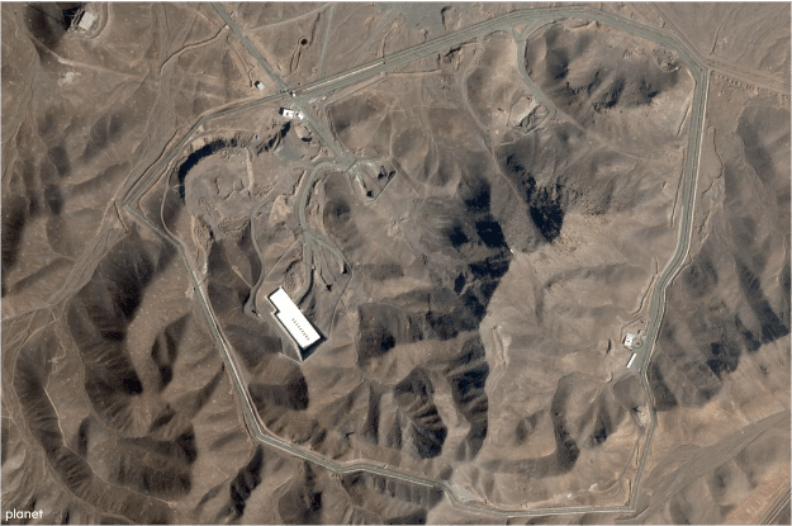
Figure 1 - Pre-strike high-resolution RGB image of the Fordow Fuel Enrichment Plant, Iran. Visible in this image are tunnels leading to underground facilities, roads, topographical features, as well as a few buildings that serve as probable infrastructure and support structures. The Guardian, Planet Labs PBC/AFP/Getty Images
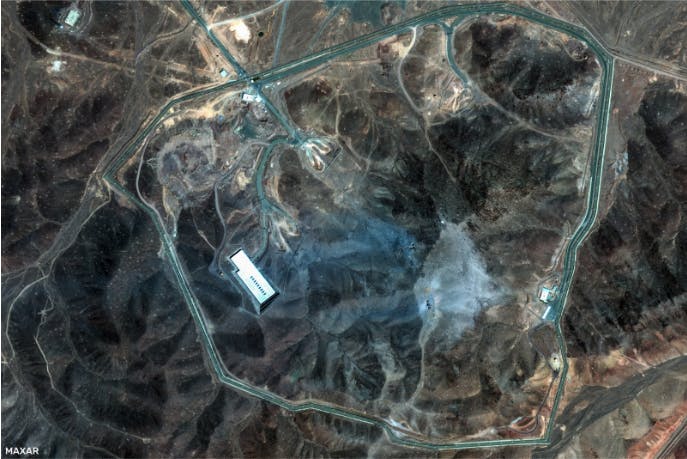
Figure 2a -Post-strike high-resolution RGB image of the Fordow Fuel Enrichment Plant, Iran.(© 2025 Maxar.)
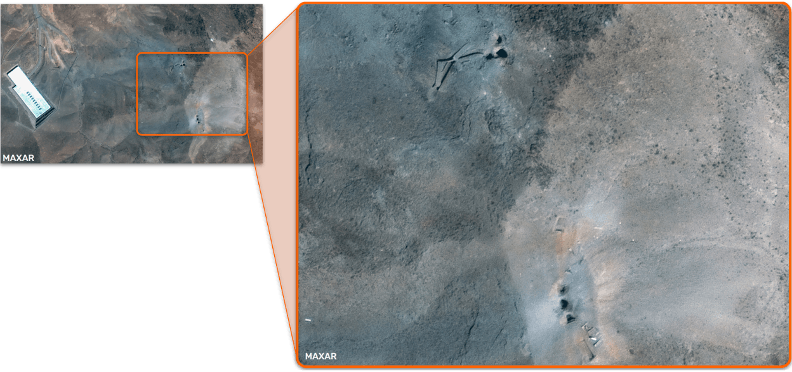
Figure 2b - Post-strike high-resolution image of the Fordow facility, with a focus on areas exhibiting visible changes. (© 2025 Maxar.)
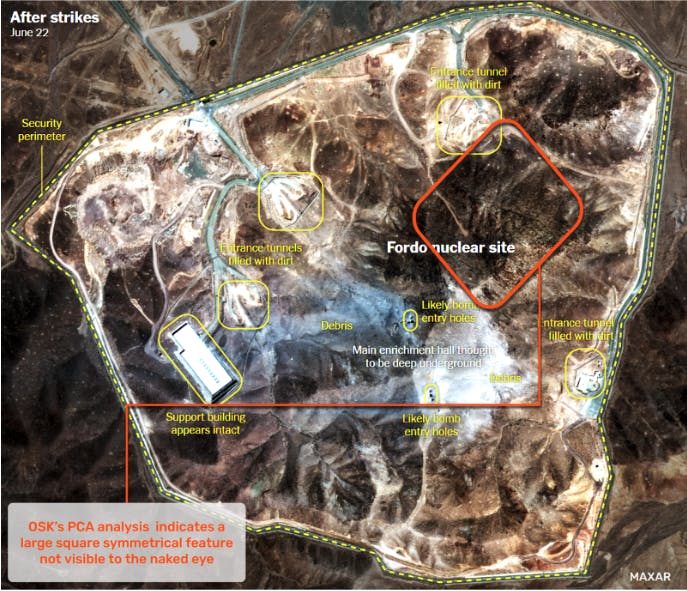
Figure 3 - Post-strike analysis of the Fordow facility conducted by Maxar and distributed to various media outlets (© 2025 Maxar). A linear feature discovered by OSK’s PCA analysis is highlighted in orange.
OSK Analytical Approach
OSK's analysts utilized proprietary data from the GHOSt constellation to confirm the strike's effects. The analysis was based on two primary assumptions:
- The bombing would cause subtle surface effects detectable by the GHOSt constellation. The detection of spectral signatures related to the surface effects would provide additional data points confirming damage to the underground facility.
- The gray material deposited on the surface is, as widely assumed, concrete. The team sought to confirm this hypothesis through spectral analysis.
This facility is a deep underground facility, under mountains and hills. Little above-ground infrastructure exists around the facility. On June 22, 2025, under Operation Midnight Hammer, B-2 Spirit stealth bombers bombed the facility with bunker buster bombs. Since then there is a lot of speculation on the actual damage inflicted by those bombs to the facility underground.
Technology and Methodology
Dataset
The primary dataset was captured by the GHOSt-5 satellite on July 7, 2025.
Characteristics
Specifications
Spectral Range: 400 - 2500 nm
Spectral Bands: 472
GSD: 8.3m
Imaging Mode: Linescan
Visible SNR: 212
SWIR SNR: 106
Collection Size: 4.3km x 12km
Underlying Algorithms
To analyze the HSI data, the team first applied Principal Component Analysis (PCA). PCA is an unsupervised dimensionality reduction technique that is particularly valuable for HSI data. It streamlines processing for subsequent steps like material classification or anomaly detection, enhances the signal-to-noise ratio (SNR) by isolating noise in lower principal component bands, and improves visualization by highlighting and differentiating scene characteristics more effectively than raw data.
It is important to note that PCA illuminates areas of high variance, which may not always be directly relevant to the specific task. In this case, the variance was used to highlight key structures against the background material.
Alternatively, to identify concrete signatures, OSK leveraged its spectral fingerprinting database. The analysis involved matching the spectral signatures of four distinct types of construction concrete from the database with the HSI data from the Fordow Mountain site.
Results
The results were compelling.
Principal Component Analysis (PCA)
The PCA immediately outlined a subtle, linear subsurface structure measuring approximately 315m x 275m. OSK analysts believe this feature may be the result of ground shift and soil settling caused by the potential collapse or damage of the underground facility. The slight changes in spectral signatures in this area may indicate a disturbance to the soil's composition.
As shown in Figure 4 and Figure 5, the PCA results highlight linear structural features beneath the mountain, which OSK interprets as features related to the underground facility at this location.
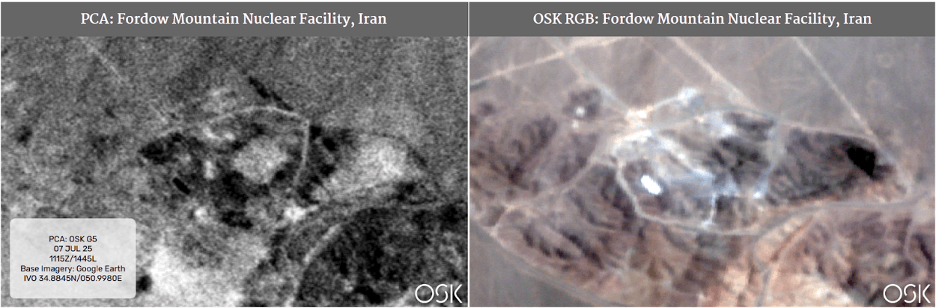
Figure 4: Results of OSK’s PCA highlighting a square, linear structural feature beneath the mountain, indicative of a subsurface anomaly, detailed in figure 5.
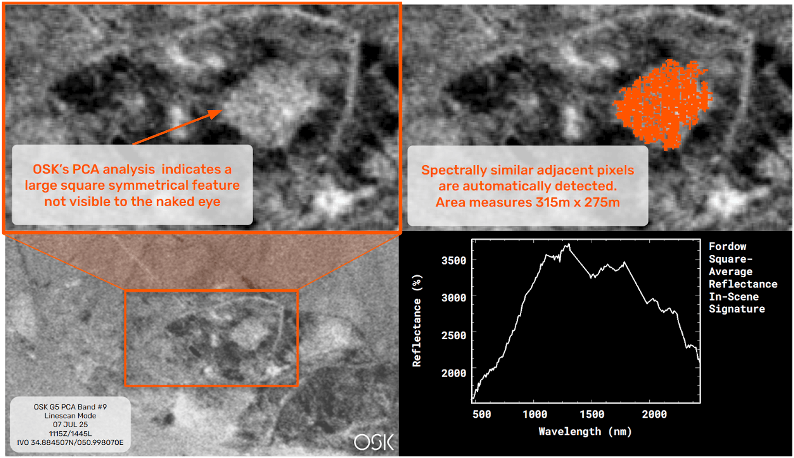
Figure 5: OSK’s PCA results illuminating a linear subsurface feature, corroborated by targeted spectral analysis using a spectral profile from the mountain's composition.
Spectral Fingerprinting
The team then used the spectral fingerprinting database. Three of the four concrete signatures were positively detected in areas adjacent to the bomb entry points. The fact that the fourth signature was not detected strengthens OSK’s statistical confidence of the results, confirming that the gray material on the surface is indeed concrete. Different types and variations of concrete will result in slightly different spectral signatures, and only the signatures most similar to that of the concrete used at Fordow Mountain will result in positive matches.
Figure 6 shows the results of the spectral fingerprinting analysis, which detected three different types of construction concrete while yielding a negative result for a fourth signature.
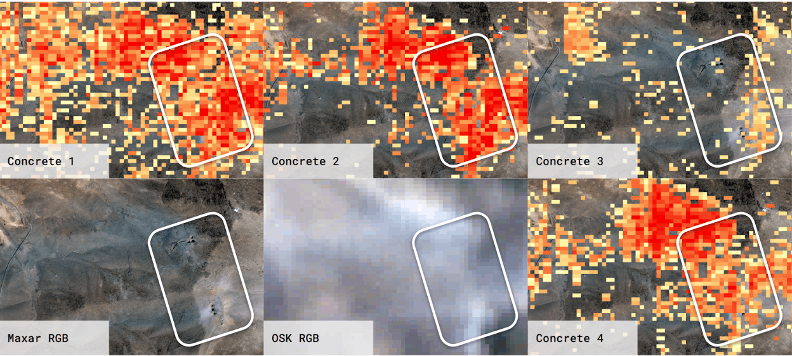
Figure 6: Spectral fingerprinting analysis identifying three distinct types of construction concrete, with a fourth spectral signature (concrete 3) yielding negative results (High-resolution RGB for comparison, © 2025 Maxar).
Conclusion
OSK's analysis provides strong evidence of damage to the Fordow Fuel Enrichment Plant. By detecting subtle changes in soil composition and possibly confirming the presence of specific construction materials, this HSI analysis validates the utility of hyperspectral technology for comprehensive damage assessment. This case study demonstrates how hyperspectral imaging provides a level of precision and insight unavailable with traditional remote sensing methods, revealing actionable intelligence from phenomena invisible to the naked eye.
The proprietary technology and analytical framework used in this assessment are not limited to a single application. OSK applies its cutting-edge spectral fingerprinting and HSI analytics across a range of other critical sectors. We are actively engaged in similar projects within the Defense and Intelligence (D&I) communities, as well as the mining and energy industries, leveraging our technology to address complex challenges from resource exploration to environmental monitoring. To learn more about how this infrastructure can be applied to new challenges, stay tuned for our next blog post, which will provide a deeper look into our advanced analytical capabilities.
Principal Investigator
Josh Magarick, Director, Government Programs
Josh Magarick generates hyperspectral imagery use cases and demand for government customers primarily for Defense & Intelligence. He manages several government contracts on behalf of OSK, and he performs technical work related to hyperspectral imagery data processing and exploitation as well as leadership, contractual, and business development tasks alike. Josh previously spent nearly 20 years with the National Geospatial-Intelligence Agency (NGA) in Springfield, VA where he also similarly led, managed, and performed hyperspectral imagery processing and automation R&D for the government. During his tenure at NGA, he supported 5 deployments to Afghanistan, chaired the Spectroradiometric Working Group, and was the recipient of two Joint Civilian Service Commendation Medals, a National Intelligence Meritorious Unit Citation, and a challenge coin from General David Petraeus.