The concept of remote sensing, quite literally the sensing of information from an object or objects from far away, has been a major endeavor from the very beginning of space exploration. With this exploration from outer space came a myriad of opportunities to not just answer questions about other worlds but also to explore our own world in the sense of what we can learn about the earth’s surface, land, water, and atmosphere. This began in 1959 when Explorer 6 sent back one of the first images of Earth from space. Space remote sensing advanced rapidly, with the first dedicated weather satellite in 1960 and the introduction of the Landsat series in 1972. As space-based digital camera imagery is being evolved, more and more advanced imaging technologies are being deployed in space to see more of the “unseen”. Hyperspectral Imaging (HSI) is one of those emerging remote sensing technologies.
What is Hyperspectral?
The sun emits a continuous spectrum of electro-magnetic (EM) energy with just a very short range of its peak emission in the visible wavelengths (~400-650 nanometers) to which the human eye is sensitive. Solar E-M emissions span a significant spectral wavelength range from high-energy X-rays, ultra-violet, visible, infrared, to radio waves. Digital cameras generally can sense energy in limited portions of this spectrum.
Newer to the scene of remote sensing are hyperspectral sensors which gather data in a different way, collecting narrow band (less than 10 nanometers) spectral information from 400 nm to 2500 nm in the case of reflective band information – reflective in the sense the energy source being detected by the sensor originated with the sun. Just as a prism can separate the wavelengths of sunlight you can see into a number of colors or bands, a specially constructed spectrometer can separate sunlight into hundreds of narrow bands. Each wavelength band then falls onto a specialized focal plane array, which contains material that can detect the incoming spectral light that carries with it spectroscopic information of the object or material from which the sunlight reflected or passed through.
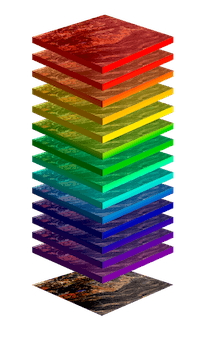
Figure 1- Hyperspectral Cube
What distinguishes hyperspectral from other imaging systems is the ability to record hundreds of narrow wavelength bands that capture the spectral “fingerprint” of the materials within each spatial pixel. These fingerprints are made up of spectral absorption features that are exploited to characterize and identify those materials or objects. This ability to simultaneously measure a large number of wavelengths, enables more information (e.g. confidence of material ID, greater number of materials, etc.) to be extracted from an image.
For example, in a standard image of three green surfaces; green tarp, grassy field, and a green painted panel, all may appear similar in a digital photo, just different levels of the color green. In hyperspectral imagery all of these materials appear very different. Solar energy at different wavelengths interacting with these surfaces get absorbed at different spectral locations in the spectrum (as per their molecular make-up) at various bandwidths , so the reflectance spectra will appear different. These small differences across the spectrum allow a hyperspectral sensor to identify each target that would otherwise be declared the same when using a traditional digital camera.

Figure 2- Spectral comparison of various different objects and paints
Hyperspectral imagery, like standard digital imagery, is a passive sensing system that refers to the sensor not providing any powered light source and relying on ambient light sources to illuminate the scene where the light may originate from the sun, moon, or other natural or man-made source. Light from the ambient source(s) reflects off a target such as the surface of the Earth and is then captured by the sensors on the satellite.
OSK’s HSI sensors gather invaluable data. In addition to gathering the data, we have the ability to exploit it and extract valuable information out of the data to generate products that can be customized for each customer. By understanding each customer’s needs in terms of what information is important, how that data or information needs to be delivered, and what format is required, OSK’s products provide substantial value to our customers.
Remote sensing companies tend to either be a data provider or analytics provider, only ingesting data made available by the former. Because hyperspectral data typically requires some specialized expertise for proper analysis, at OSK, we’ve addressed this challenge by being both a data acquisition company and an analytics company. This allows us to offer custom and unique solutions to our customers.